
There was once a king who had three daughters, whom he cherished as the apple of his eye. As his limbs grew weak and his hair turned gray, he often wondered which of his three daughters should become queen after his death. It was a difficult choice because he loved them all equally, and they were all equally beautiful. Finally, he decided that the one who loved him the most would be made queen. He called his daughters to him and spoke to them thus:
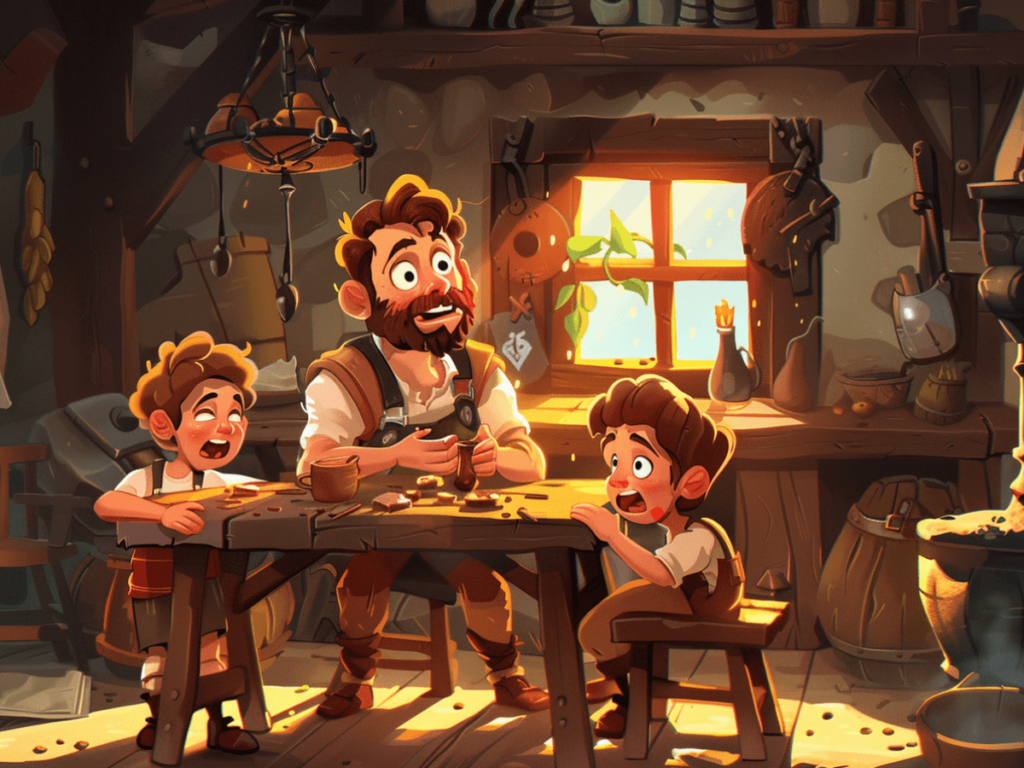
“My dear daughters, I am old, as you can see, and I don’t know how much longer I will be with you. Therefore, I want to decide which of you will be queen after my death. But first, I would like to know, my dear children, how much each of you loves me. So, my eldest daughter, you speak first: how do you love your father?”
“Oh, my father, you are dearer to me than gold!” the eldest daughter replied, kissing her father’s hand.
“Very well; and you, middle daughter, how do you love your father?”
“Oh, my dear father, I love you like my green garland!” said the middle daughter, wrapping her arms around her father’s neck.
“Very well; and you, my youngest daughter, how do you love me?”
“I, dear father, love you as much as salt!” said Elizabeth, looking sweetly at her father.
“Oh, you worthless girl, do you value your father only as much as salt?” her older sisters scolded her.s
“Indeed, I love him as much as salt!” Elizabeth confirmed once more, looking even more lovingly at her father.
But her father was not pleased at all. The king was extremely angry that his daughter valued him only as much as salt, which everyone sprinkles between their fingers and scatters.
“Get out of my sight!” he shouted at her, “if you value me only as much as salt! When the time comes that salt is worth more than gold, then you may return and become queen.”
Elizabeth was too heartbroken to say a word when her father rejected her love in such a way. She was used to obeying her father’s every word to the letter, and she knew she could not stay at home with her sisters anymore. So, she gathered her belongings and left. She wandered through mountains and valleys until she came to a dark forest. There, an old woman suddenly appeared before her.
“Elizabeth, Elizabeth, tell me, where are you going, and why are you crying so bitterly?”
“Oh, my dear old woman, what can I tell you, when you cannot help me!”
“Oh, my girl, just tell me your troubles; perhaps I can offer you some advice. Don’t you know that where there is wisdom, there is also knowledge?”
Elizabeth told the old woman everything, wishing only to prove to her father that she truly loved him. The old woman already knew everything that Elizabeth was about to say because she was a wise woman, a soothsayer. She agreed with Elizabeth and invited her to stay with her and serve her. Elizabeth was glad to have found someone to confide in, and she gratefully followed the old woman to her little cottage in the forest. They shared what little they had, and the old woman fed Elizabeth as best she could, which was a relief because Elizabeth was both hungry and thirsty.
“And now,” said the old woman, “let’s get to work. Can you spin, weave, and tend sheep? Can you milk them too?”
“I don’t know how to do any of these things yet, dear old woman, but I will learn if you show me,” Elizabeth replied.
“Well, I’ll show you everything; in time, it will all be useful to you.”
Elizabeth quickly got to work, like a bee. Although she didn’t know everything at first, she quickly adapted to everything, just like a girl who was born to be in the world. Her rolled-up sleeves and white apron suited her as if she were born to this life.
Meanwhile, back at home, Elizabeth’s sisters were living the high life. They constantly pampered their father, wrapped themselves around his neck, and would have almost eaten him with their love because he gave and provided whatever their hearts desired. The eldest dressed in finer clothes every day, adorning herself with gold; the middle one organized feasts and dances; both of them lived as they pleased. But the king soon noticed that his eldest daughter valued gold more than him, and when the middle daughter revealed she wanted to get married, he realized that her love for him would wither away as soon as she got her wedding wreath. He suddenly remembered Elizabeth, but what of her? There was no news of her at all.
“Ah, what?” he dismissed the thought of her. “After all, she only loved me as much as worthless salt.”
Once, there was supposed to be a great feast at the castle, perhaps even suitors were coming for the middle daughter. But the cook came running as if possessed.
“My lord king,” he stammered, “a great disaster, a great disaster!”
“What is it, have you lost your mind?” said the king.
“That’s just it, my lord king, my mind is failing me. All the salt we had, whether it dissolved, or simply disappeared into the earth, but there isn’t a single grain of it left. How am I supposed to season the food?”
“You fool! Then send for more!”
“Where should I send for it, when the same has happened in every house and there is no salt left in the entire kingdom!”
“Then season with something else or prepare dishes that don’t need salt!” the king finally dismissed the cook impatiently.
The cook thought, as the lord commands, so it must be, and he cooked unsalted dishes; first, whatever came to his mind, and then only sweet dishes. These were strange feasts, tasteless! And the guests slowly drifted away from the king, and no new ones came. Why would they, when even the poorest of houses had “bread with salt and good will,” which the king could no longer offer. The king wandered around discontented; his daughters were as if paralyzed, wondering where their golden times had gone. Yes, plenty of gold, but not a grain of salt, and even if they sent to the ends of the earth for it, it was gone and gone!
People slowly lost all desire for food; now everyone longed for just a tiny grain of salt on their tongue. Even the livestock suffered; cows and sheep stopped giving milk because they had no salt. People wandered around dazed and fell into sickness. The king and his daughters looked like shadows, so sickly that one could hardly recognize them. It was a divine punishment on the entire land. Now they would have given their weight in gold to anyone who could bring them just a grain of salt.
The king finally realized what a precious gift salt was, but he could hardly bear his misery when he remembered Elizabeth and the wrong he had done to her.
Meanwhile, our Elizabeth was faring very well. There was no task she had not learned and adapted to; she knew nothing of poverty. She didn’t even know what had happened at her father’s home and in his kingdom. But the wise woman knew everything, and she knew when the time was right for everything. So, one day, she called Elizabeth and said:
“My girl, I told you that in time, all things come to pass; your time has come, and it is time for you to return home.”
“Oh, my dear old woman, how can I go home when my father doesn’t want me?” said Elizabeth, bursting into tears.
“Don’t cry, my girl, everything will be alright. Salt has become more valuable than gold there; you may go to your father now.”
And with that, the soothsayer told Elizabeth everything she hadn’t known, and finally added:
“You have served me faithfully; now tell me, what do you wish as a reward for your webfaithful service?”
“You have advised me well, you have cared for me well, dear old mother! For all this, I thank you. I wish for nothing more than a pinch of salt, which I will take as a gift to my father.”
“And nothing else? Don’t you know I can do anything for you?” the wise woman asked once more.
“I wish for nothing more than the salt!” replied Elizabeth.
“Well, if you value salt so highly, may you never lack it,” said the soothsayer finally. “I will give you nothing more than this wand. When the south wind blows, go with the wind, cross three valleys and three mountains; then stop and strike the ground with this wand! Where you strike, the ground will open, and you go in! Whatever you find there is yours; it will be your wedding dress.”
Elizabeth thanked her for everything; she took the golden wand and the full pouch of salt, and sadly set off — sadly, for she had always been happy with the old woman. But she comforted herself, thinking that she was not saying goodbye forever to the good old woman, that she would come back for her, as long as her father forgave her. The old woman just smiled at this and said:
“Stay good and honest, my girl, and it will go well with you forever. Don’t worry about me in the least!”
As they talked, they reached the edge of the forest. And when Elizabeth wanted to thank the good old woman once more, the old woman was gone — she had disappeared without a trace, and Elizabeth was left all alone. Her longing for her father grew even stronger, so she hurried off towards her father’s castle.
When she arrived among her own people, it was clear that, although they had not seen her for a long time, and even though her head was wrapped in a scarf, they did not recognize her and refused to let her see the king.
“Oh, let me in,” insisted Elizabeth, “for I bring a gift to the king more valuable than gold, one that will surely cure him!”
They relayed this to the king, who immediately ordered that she be brought before him. When she arrived, she asked for bread to be brought to her. The king ordered it to be fetched, but as he did so, he sighed deeply:
“We have bread, but we have no salt!”
“What we don’t have, we can have!” Elizabeth said, cutting a slice of bread, untying her pouch, sprinkling salt on the bread, and handing it to the king.
“Salt!” the king exclaimed in joy. “Oh, dear woman, this is a precious gift; how can I repay you? Ask for anything you wish, and you shall have it!”
“I ask for nothing, dear father, but for you to love me as much as salt!” Elizabeth replied, her voice as sweet as when she used to speak to her father, and she uncovered her head.
At that moment, the king nearly fainted from joy when he recognized his beloved Elizabeth. He begged her not to regret what had happened. She only caressed and embraced her father, never letting her loving eyes leave him. “Everything turned out for the best!” she said.
News quickly spread throughout the castle and the town that the king’s youngest daughter had returned and that she had brought salt. Everyone rejoiced at the news. Elizabeth’s sisters were also pleased, not so much because their sister had returned, but because they would finally get a taste of that precious salt. And Elizabeth, forgetting all the wrongs her sisters had done to her, greeted them with salted bread. She generously shared salt from her pouch with everyone who came. And when her father, afraid that they might run out of salt again, urged her not to give it all away, “slowly, with good measure,” she always replied:
“There’s plenty more where this came from, father!”
Indeed, no matter how much salt she took out, there was always more in the pouch, as if it would never run out. Everything in the kingdom warmed up, just like in the sunshine!
The king’s illness vanished completely, as if it had been lifted from him. In his joy, he summoned the town’s elders and the leaders of the country, and he proclaimed Elizabeth the queen. Then, when Elizabeth was declared queen under the open sky, she felt a warm breeze gently blow on her face; it was blowing from the south. She immediately told her father everything that the wise woman had instructed her to do. She followed the wind, and after crossing three valleys and three mountains, she stopped with the wand and struck it on the ground. As she struck, the earth opened, and Elizabeth entered the ground.
Suddenly — she did not even know how she got there — she found herself in a magnificent palace, which looked as if it was made entirely of ice: the ceiling, walls, and floor, all sparkled and gleamed as if emitting sparks. On the sides, there were shiny tunnels, and from these tunnels, tiny people with burning lanterns came running out to greet Elizabeth:
“Welcome, welcome, queen! We have been expecting you; our lady has ordered us to show you around and to show you everything because it all belongs to you!”
They chattered around her, waving their lanterns and scurrying about, climbing up and down the walls like flies, and the walls glittered all around like precious gems. Elizabeth walked as if blinded by so much beauty. The little people led her through corridors and tunnels, where icy stalactites hung from the ceilings, sparkling like pure silver. They even led her to a garden where there were red icy roses, daisies, and all kinds of flowers, a marvel to behold. The little people picked the most beautiful rose and handed it to their new queen. She took it and smelled it, but the rose had no scent.
“But what is this?” the queen asked. “I have never seen such beauty before!”
“This is all salt!” the little people replied.
“But really? Is this salt growing here?” the queen wondered, thinking it would be a pity to take even the smallest piece from such a wonder.
But the little people guessed what she was thinking and said:
“Go ahead, Elizabeth; take as much as you like; you will never run out of it, and you will never lack for it again!”
Elizabeth thanked the little people graciously, said her farewells to them, and exited the earth. But the ground remained open behind her.
When she returned home and showed the rose to her father and told him everything, the king saw that the old woman from the little cottage had indeed provided his daughter with a wedding dress far richer than anything he could have given her. But Elizabeth did not forget the old woman from the cottage either. She had a beautiful carriage prepared immediately, and she set off with her father to find the old woman, vowing never to be separated from her again.
Elizabeth knew the way well, she recognized every path in the forest, but no matter how many times they searched the forest high and low, there was no sign of the cottage, and not a word or trace of the old woman. Only now did they realize what kind of woman she was and that all their searching would be in vain. They returned home. The pouch that had held the salt was now empty, but Elizabeth knew where salt grew: they took as much as they needed, and they never ran out of it, never again did they lack it!
From the collection of Slovak legends and rumours collected by the Slovak storyteller Pavol Dobšinský.

Salt more precious than Gold