

Chapter 1: A New Friend
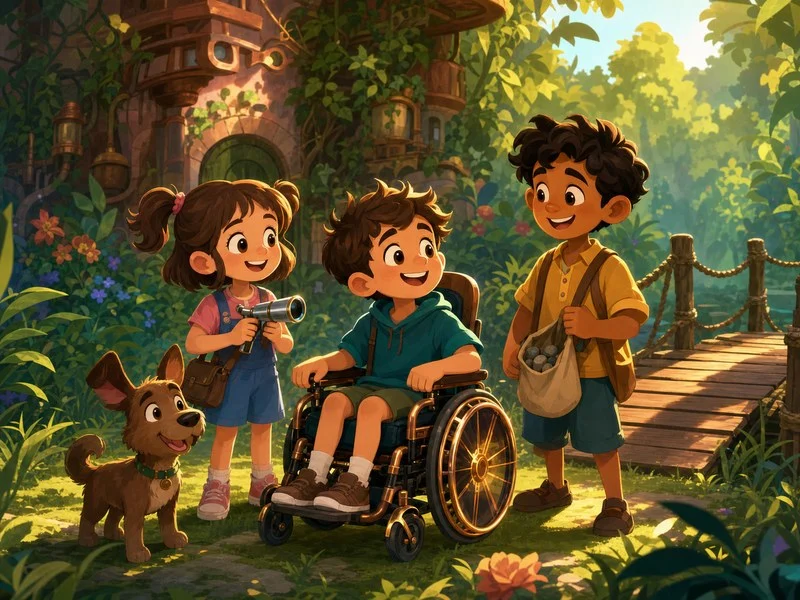
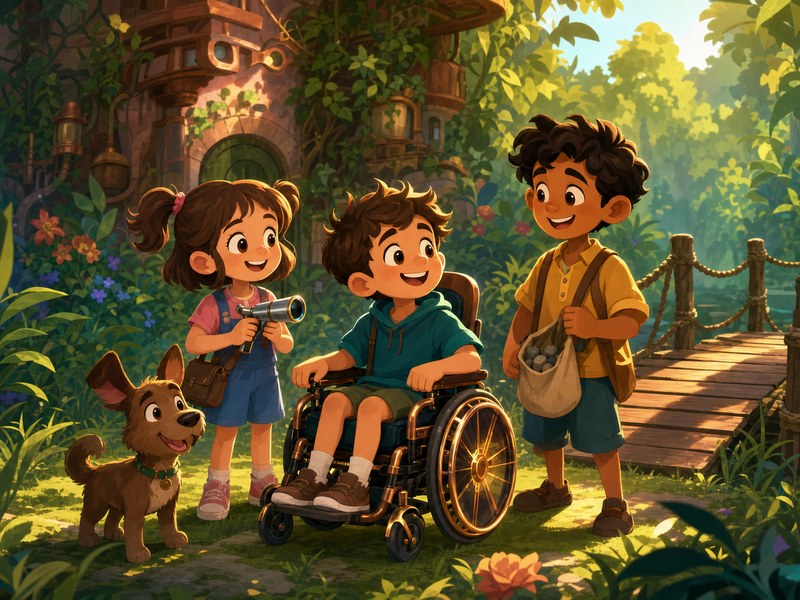
The summer sun rolled gently down Maple Lane, turning every window gold. Max wheeled himself along the sidewalk with his backpack hooked neatly behind his chair and his head full of plans. He was ten years old, curious about almost everything, and especially curious about things that clicked, spun, hummed, or opened in unexpected ways.
Max had used a wheelchair for as long as he could remember. To him, it was not a sad thing or a strange thing. It was part of how he moved through the world, the same way Sara moved with quick feet and Luis moved with pockets full of stones. Max knew the smooth places in the pavement, the tricky roots near the library, and the little downhill slope that made his wheels sing if he leaned just right.
That afternoon, the neighborhood park was full of laughter. Near the swings, a girl with curly pigtails was shouting, ‘Higher, Luis! Higher!’ while a boy with scuffed sneakers pumped his legs toward the blue sky. Max slowed at the gate. He wanted to join them, but wanting and asking were not always the same size inside his chest.
Then something warm and wet bumped his hand.

Max looked down and laughed. A small brown dog stood beside his wheel, one ear floppy and one ear pointing bravely upward, as if it had heard an adventure coming before anyone else. Around the dog’s neck hung a copper-colored badge shaped like a spinning wheel.
‘Hello there,’ Max said, scratching behind the silky ears. ‘Are you lost, or are you exactly where you meant to be?’
The dog wagged so hard that his whole body wiggled. Then he trotted toward the park, stopped, and looked back over his shoulder.
‘You want me to follow?’ Max asked.
The dog gave one bright bark.
So Max followed. The dog led him straight to the swings, where the girl and the boy turned to stare, first at the dog, then at Max, and then at the mysterious badge shining on the dog’s collar.
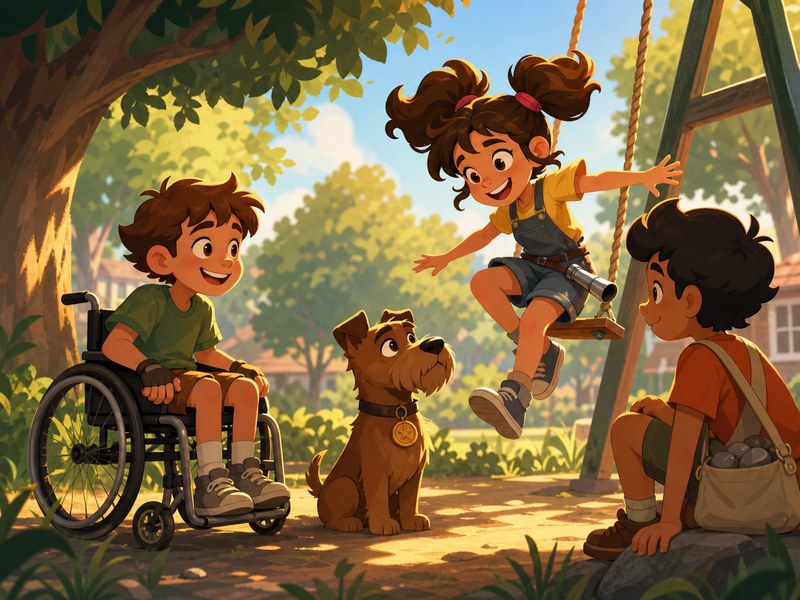
‘Is he yours?’ the girl asked. ‘He’s wonderful.’
‘I think he just adopted me,’ Max said.
‘I’m Sara,’ said the girl. ‘I collect space facts and very good questions. This is Luis. He collects rocks and occasionally terrible jokes.’
‘They’re not terrible,’ Luis said. ‘They’re geological.’
Max grinned before he could stop himself. The tight little knot in his chest loosened. ‘I’m Max. I collect useful inventions, even imaginary ones.’
The dog sat between them as proudly as a mayor opening a festival. And just like that, three children who had been strangers five minutes before became a team.
Chapter 2: The Mysterious Badge
They played until the shadows stretched long across the grass. Max turned faster than Luis expected, Sara invented a game called Asteroid Tag, and the little brown dog served as referee, though he seemed to think every round ended with belly rubs.
When they flopped beneath the oak tree to rest, Sara leaned closer to the dog’s collar. ‘That badge has the same pattern three times,’ she said. ‘A wheel, a spark, and a tiny star.’
Luis took a smooth gray stone from his pocket and held it near the badge. ‘It tingles,’ he whispered. ‘Like the stone is listening.’
The dog looked at Max. Then at Sara. Then at the badge.
‘May I?’ Sara asked softly.
The dog dipped his head. Sara pressed the center of the copper wheel.

A chime rang out, clear as a spoon touching a crystal glass. Max’s wheelchair shimmered. The wheels folded inward, not roughly, but carefully, like petals closing for the night. A warm hum rose through the frame, and the chair lifted three inches above the grass.
Max grabbed the rims, then stopped. The chair was steady. Safer than a swing. Softer than a boat on a calm pond.
‘It’s a hover-chair,’ Luis breathed.
‘It’s impossible,’ Sara whispered, smiling so widely that she clearly hoped it was not.
Max turned in a slow circle above the grass. He could feel the chair responding to him, not dragging him somewhere, not showing off, but asking where he wanted to go. For the first time that day, the park did not have edges. It had routes.
The dog barked twice and raced toward a narrow lane behind the oak tree.
‘He didn’t bring us together just to play,’ Max said. ‘He wants to show us something.’
The badge chimed again, and the chair settled back onto its wheels. Then the dog ran, and the three children followed him out of the park and across a little wooden footbridge none of them remembered seeing before.

Beyond the bridge stood a tall house wrapped in vines. Its paint had faded to the colors of old storybooks. The iron gate was rusty, but at its center was the same symbol as the badge: a wheel, a spark, and a star.
‘This is not just a house,’ Sara said.
‘It’s a clue,’ said Luis.
Max rested one hand on the copper badge. ‘Then let’s solve it carefully.’
Chapter 3: Secrets in the Workshop
The front door opened with a sigh. Inside, dust floated in the sunlight, but the house did not feel abandoned. It felt paused, as if someone had stepped out for tea and forgotten to come back for several years.
The first room was crowded with inventions. Brass birds clicked their beaks on perches. A glass jar held a small blue glow labeled Moonlight, rainy Tuesday. A wooden mouse with wheels for feet carried a thimble across the floor and bowed to them politely.
But Max saw the drawings first.
They covered one wall from floor to ceiling: wheelchairs with folding ramps, wheelchairs with lanterns, wheelchairs that could climb steps, glide over puddles, and unfold little tables for sandwiches. Every page was signed with the same careful initials: A. Albert.
‘My chair,’ Max said quietly. ‘The shape is different, but the joints are the same.’

The dog stood beneath a portrait above the fireplace. It showed a white-haired inventor in a wheelchair, smiling as if he had just thought of something kind and ridiculous at the same time. A small brass plate on the frame read: Professor Algernon Albert, Maker of Useful Wonders.
Sara looked from the portrait to the dog. The dog’s eyes were bright and pleading.
‘Oh,’ she said. ‘Max… I think the dog is Professor Albert.’
Luis found a stack of journals inside a desk drawer. The pages were filled with sketches and notes, but the last entry had been written in a shakier hand.
Max read it aloud: ‘Tobias wants the Wonder Engine before it is ready. I have hidden the chair and locked the workshop below. If I cannot speak for myself, follow the wheel, the spark, and the star.’
At that moment, the fireplace clicked. The stones slid apart to reveal a spiral staircase descending into golden light.
The dog barked once, not excitedly this time, but urgently.
‘Wheel, spark, star,’ Max said. ‘We follow.’
Chapter 4: The Man Who Wanted Too Much
The hidden workshop beneath the house was larger than the house itself. Lamps glowed along the walls. Drafting tables stood in neat rows. In the center of the room, a great round machine slept beneath a glass dome, its copper gears turning very slowly, as if dreaming.
Beside it, on a velvet cushion, rested a silver helmet shaped like an upside-down flower. Copper petals curled around its humming center.
The dog placed both front paws on the cushion and looked at Max.
‘This must change him back,’ Max said.
‘I wouldn’t touch that,’ said a voice from the shadows.
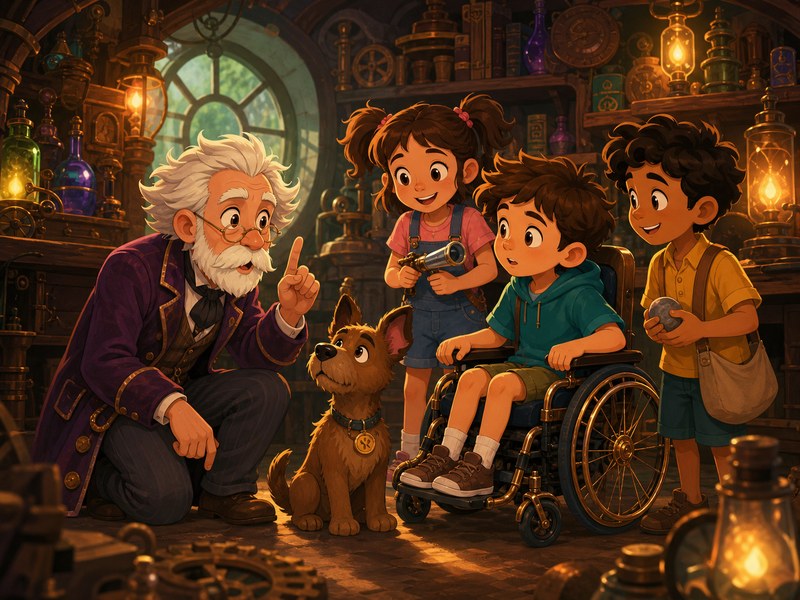
A thin white-haired man stepped into the lamplight. His coat was dusty, his shoes were polished, and his face had the tired look of someone who had spent a long time pretending not to be afraid.
‘Professor Tobias Greed,’ Sara whispered, reading a name stitched inside one of the journals.
The man bowed stiffly. ‘I was Professor Albert’s partner. This workshop should have been mine too.’
The dog growled, low and wounded.
Tobias looked away. ‘I only meant to prove I was brilliant. Albert made wonders that helped people, and everyone loved him for it. I wanted one invention that would make them look at me that way.’
‘So you used the helmet,’ Luis said.
‘I tried to take Albert’s cleverness,’ Tobias admitted. ‘The Form-Changer does not work that way. It changed him into the shape I treated him as: loyal, useful, silent. A dog.’
Max felt anger rise in him, but he held it carefully, the way Albert’s journal had said to hold a candle in the wind. ‘Then help us change him back.’
Before Tobias could answer, the great round machine under the dome woke with a shudder. The badge on Max’s chair flashed. The helmet glowed. All around the room, inventions began to stir.
A calm mechanical voice filled the workshop: ‘Wonder Engine active. True makers required. Test beginning.’
Chapter 5: The Three True Measures
The floor lit with three circles: one marked with a wheel, one with a spark, and one with a star. Above them, the glass dome around the Wonder Engine began to close like a giant eye.
‘If it locks,’ Tobias said, suddenly pale, ‘the workshop will seal itself for another hundred years.’
‘Then we don’t force it,’ Max said. ‘We listen.’
The first circle, the wheel, rolled away across the floor, becoming a path of shining lines. It wound between tables, over cables, and around a gap where the floor had opened to reveal old gears turning below. Max’s chair hummed. He guided it forward, not fast, not fearlessly, but steadily. The chair unfolded a narrow bridge from its frame, and Sara and Luis crossed behind him.
‘Courage is not rushing,’ said the mechanical voice. ‘Courage is choosing the careful path.’
The wheel circle went dark.
The second circle, the spark, burst into a dozen glowing clues that scattered across the room. Sara noticed they were not random. They formed constellations. ‘It’s a map!’ she cried, pointing from one light to another. ‘Not of stars. Of switches.’
Luis used his lodestone to find the hidden copper switches beneath the workbenches. One by one, the children pressed them in the order Sara called out. The humming calmed.
‘Curiosity is not grabbing,’ said the voice. ‘Curiosity is asking how things connect.’
The spark circle went dark.
Only the star remained. It floated above the silver flower helmet and settled, softly, over the little brown dog’s head.
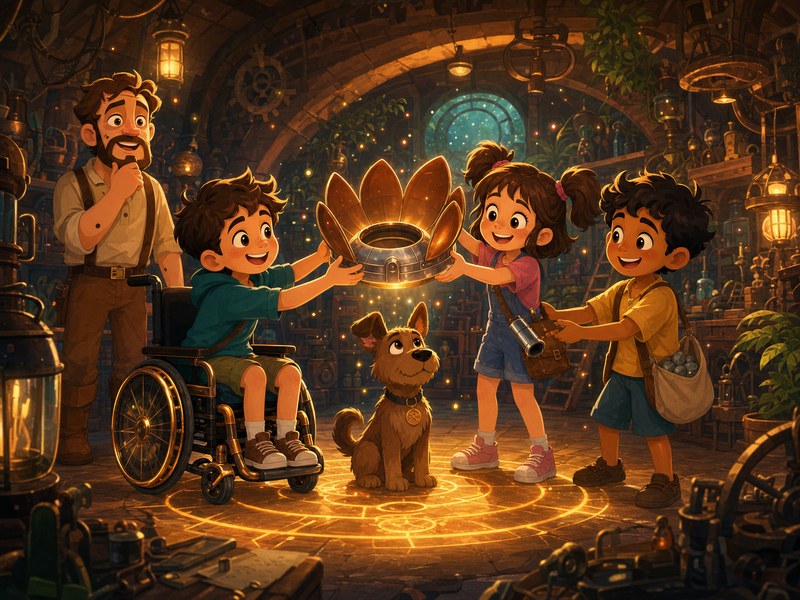
Tobias stepped backward. ‘I can’t. He will never forgive me.’
Professor Albert, still a dog, looked at him. He did not bark. He simply waited.
Max understood then that the last test was not a puzzle of gears or maps. It was the hardest kind of puzzle: the kind inside a person.
‘Say what is true,’ Max told Tobias. ‘Not what makes you look clever. Just what is true.’
Tobias knelt. His voice shook. ‘Albert, I was jealous. I hurt you because I wanted your light instead of learning how to make my own. I am sorry. If you come back, I will spend the rest of my days helping repair what I broke.’
The helmet opened like a silver flower at sunrise. The workshop filled with warm light. The dog lifted gently into the air, not frightened, not trapped, but held as carefully as a wish.
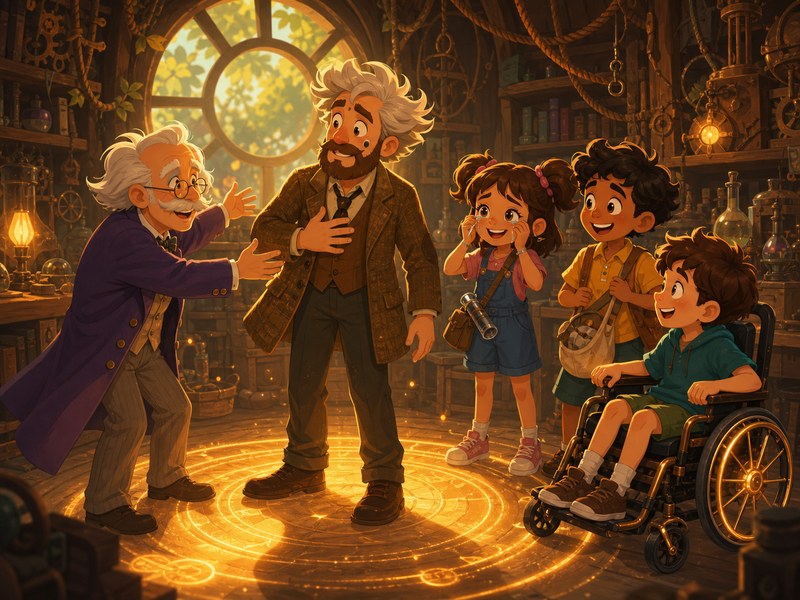
When the light faded, a man sat where the dog had been: white-haired, kind-eyed, and wearing a coat with one pocket full of tiny screws. Professor Albert blinked at his hands, then at the children, then at Tobias.
‘Well,’ Albert said, his voice creaky from disuse, ‘that was an unusually long afternoon.’
Luis laughed first. Then Sara. Then Max. Soon even Tobias was laughing and crying at the same time.
Albert hugged the children, thanked them properly, and turned to his old partner. Tobias bowed his head.
‘Tea first,’ Albert said. ‘Then apologies. Then work. There is always work for people who are ready to make useful wonders.’
The Wonder Engine gave one final soft chime.
‘Kindness accepted,’ it said.
Chapter 6: Wheels of Wonder
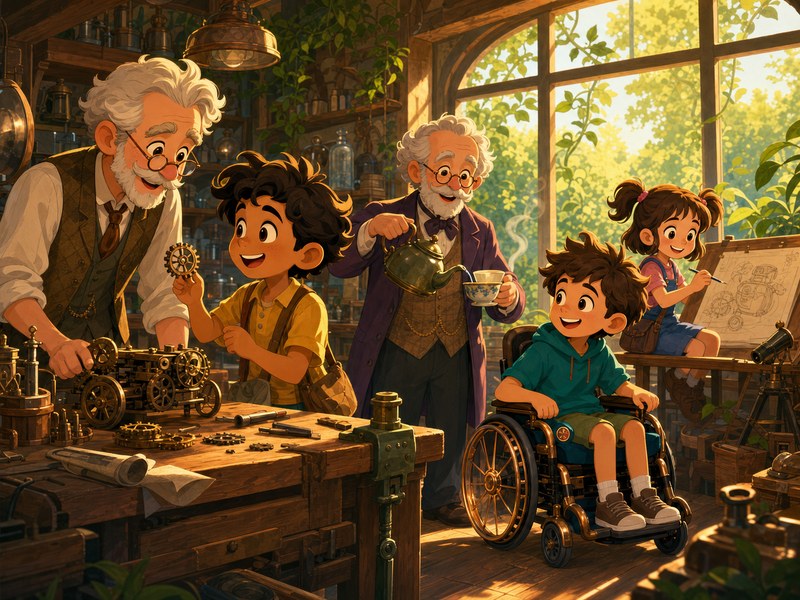
By the next morning, the old house at the end of the footbridge no longer looked forgotten. The windows were open. The front step had been swept. A new sign hung on the gate, painted in careful blue letters: The Albert Workshop: Useful Wonders, Wheels Mended, Questions Welcome.
Sara claimed a drawing board by the east window and began sketching a pocket telescope that could unfold into a planetarium. Luis sorted stones beside Albert’s mineral magnets and announced that geology was clearly the most magical science. Tobias made tea, burned the toast, apologized to the toast, and tried again.
And Max sat beside Professor Albert while the inventor fitted a small copper badge to the side of his wheelchair. It matched the one on the dog’s old collar: a wheel, a spark, and a star.
‘It will not do everything,’ Albert said. ‘No invention should. But it will help when a path is missing, when a gate is too narrow, or when an adventure needs a little lift.’
Max ran his fingers over the badge. ‘Why me?’
Albert smiled. ‘Because you listened before you hurried. Because you asked before you took. And because wheels of wonder should belong to someone who knows they are not only for going faster. They are for helping everyone come along.’
That afternoon, Max, Sara, and Luis rolled, ran, and wandered back through the park together. No one stood outside the circle of laughter anymore. The circle had grown wider.
And if you ever cross a little wooden footbridge and hear gears humming kindly behind a vine-covered wall, do not be afraid. Knock on the tall blue door. Ask your question. Bring your oddest idea.
Inside, you may find a boy in a wheelchair, a girl with a telescope, a boy with pockets full of stones, and two old inventors learning, at last, how to build wonders that leave room for everyone.
Commentary